



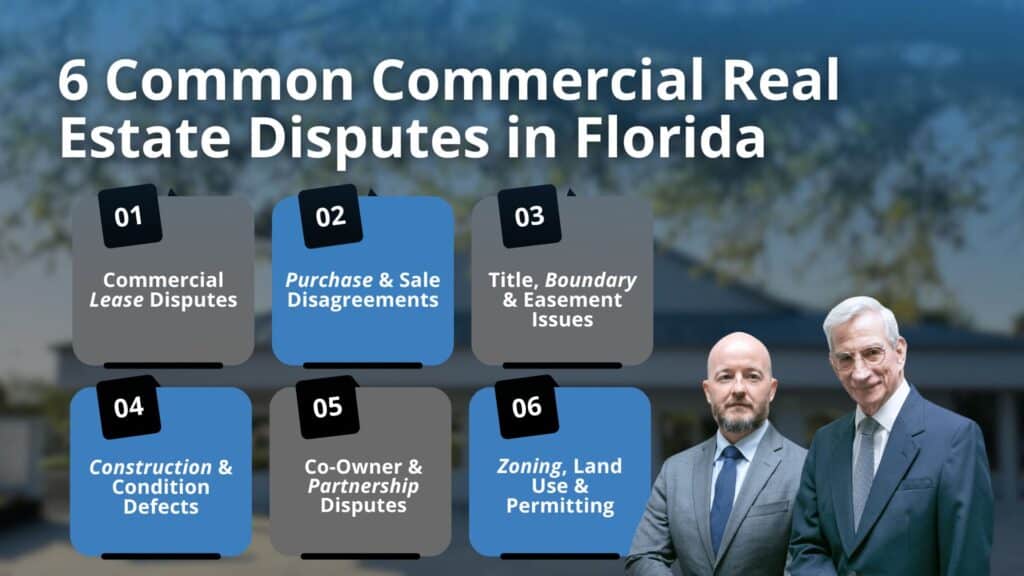
Most commercial real estate disputes in Florida fall into a handful of familiar categories: fights over a lease, a sale that goes sideways, a title or boundary problem, construction and condition issues, disagreements between co-owners, and run-ins with local zoning.
The details vary, but the patterns don’t. Knowing which category you’re in tells you a lot about how serious the problem is and how it’s likely to get resolved.
Here’s a plain-language look at the disputes and litigations we see most often and what tends to work when they come up.
What Counts as a Commercial Real Estate Dispute?
A commercial real estate dispute is any legal disagreement tied to property used for business: office space, retail, industrial, land held for development, or an investment property.
It can involve a landlord and tenant, a buyer and seller, business partners who co-own a building, a contractor, or a local government. What makes these different from residential disputes is the money and complexity involved.
Leases run longer, contracts are more detailed, and both sides usually have more at stake, which is exactly why getting ahead of a problem early matters so much.
Common Types of Commercial Real Estate Disputes
Here are the disputes that come up most often, and what’s usually behind them.
Commercial lease disputes
Lease disagreements are the most common commercial real estate dispute by far. They tend to center on unpaid or disputed rent, common area maintenance (CAM) charges, who is responsible for repairs, permitted-use clauses, early termination, and holdover tenants who stay past the lease term.
Commercial leases in Florida are governed largely by Chapter 83, Part I of the Florida Statutes, which treats business tenants very differently from residential ones. Because commercial tenants have fewer built-in protections, the written lease is everything, and small ambiguities cause big fights.
A single unclear phrase about who pays for a roof repair, or how CAM charges get calculated, can mean tens of thousands of dollars over a multi-year term.
Purchase and sale disagreements
These arise when a deal to buy or sell commercial property breaks down. Common flashpoints include a party trying to back out, disputes over contingencies and inspection periods, earnest money that both sides claim, misrepresentations about the property’s condition or income, and a seller or buyer who simply fails to close.
The purchase agreement usually controls the outcome, so how it was drafted matters enormously. When a seller refuses to close on a signed contract, a buyer may even sue for specific performance, asking a court to force the sale rather than just award damages.
Title, boundary, and easement disputes
Sometimes the problem is the land itself. Title defects, competing ownership claims, unclear boundary lines, and easement disagreements (who has the right to cross, park, or access a portion of the property) can stall a project or a sale for months.
These often surface during due diligence, which is the best time to catch them.
Construction and property condition disputes
When a building has defects, unfinished work, or conditions that were not disclosed, disputes follow. These can pit owners against contractors, buyers against sellers, or tenants against landlords over who pays to fix what.
Many of them trace back to a condition that a thorough inspection would have flagged before closing.
Co-ownership and partnership disputes
Commercial property is often owned by partners, an LLC, or a group of investors. When those owners disagree about selling, financing, managing, or dividing income, the dispute is as much a business-law matter as a real estate one.
These can be some of the most contentious cases because the relationship, not just the property, is on the line. When co-owners reach an impasse, one option is a partition action, which asks a court to divide the property or force its sale so each owner can cash out.
Zoning, land use, and permitting disputes
Plans for a property can collide with local rules. Zoning restrictions, permit denials, code enforcement, and land-use decisions by a city or county can block or delay what an owner wants to do.
These disputes involve local government, which adds its own process and timelines.
How Do These Disputes Usually Get Resolved?
Not every dispute ends up in a courtroom. In fact, most don’t. Start by checking your contract, because many commercial leases and purchase agreements spell out how disputes must be handled, sometimes requiring mediation or arbitration before anyone can file suit.
From there, commercial real estate disputes generally move through one or more of these paths, roughly from least to most formal:
- Negotiation. The fastest and cheapest route. Many disputes settle once each side understands its position and the cost of the alternative.
- Mediation. A neutral third party helps both sides reach a voluntary agreement. Florida courts often require or encourage mediation before trial under the state’s mediation rules.
- Arbitration. A private decision-maker hears the case and issues a binding ruling. Many commercial contracts require it, so check your lease or purchase agreement.
- Litigation. When the stakes or the disagreement are too big to settle, the case goes to court. It’s the most expensive and time-consuming option, but sometimes it’s the only way to protect your rights.
Which path fits depends on your contract, the amount in dispute, and how much the ongoing relationship matters.
How to Avoid a Dispute in the First Place
The cheapest dispute is the one that never happens, and most are preventable. Three habits do the heavy lifting: clear contracts, real due diligence, and early legal review.
Have an attorney draft or review leases and purchase agreements before you sign, so the terms are precise and the risky clauses are caught early.
Do your homework on the property before closing, including a commercial property inspection and, where appropriate, an environmental assessment, so condition and disclosure surprises don’t turn into lawsuits later. And when something feels off, raise it early.
A quick conversation at the first sign of trouble is far cheaper than a fight after positions have hardened. Keep good records throughout, too: signed agreements, written correspondence, and payment history. If a dispute does arise, solid documentation is often what decides it.
Related Questions to Explore
What’s the most common commercial real estate dispute?
Lease disputes. Disagreements over rent, CAM charges, repairs, and holdover tenants make up the largest share of commercial real estate conflicts, largely because commercial leases are long, detailed, and give business tenants fewer default protections.
Do I need a lawyer for a commercial property dispute?
In most cases, yes. The dollar amounts, the contracts, and the procedures are complex enough that going it alone is risky. Even a short consultation early can tell you whether you have a strong position and what a resolution might look like.
How long do these disputes take to resolve?
It varies widely. A negotiated settlement can close in weeks, mediation in a month or two, and full litigation can take a year or more. The path you take, and how willing both sides are to settle, drives the timeline more than anything else.
What’s the difference between mediation and arbitration?
In mediation, a neutral helps the parties reach a voluntary agreement, and no one is forced to settle. In arbitration, a neutral hears the case and issues a binding decision, much like a private judge. Many commercial contracts specify one or the other, so read yours before a dispute arises.
Can a commercial dispute be resolved without going to court?
Usually, yes. Most commercial real estate disputes settle through negotiation, mediation, or arbitration well before trial. Litigation is the last resort, not the default. Acting early and knowing what your contract requires gives you the best shot at a faster, less expensive resolution.
When to Call a Real Estate Attorney
The best time to call is before a disagreement becomes a lawsuit: when a lease term is unclear, a deal starts to wobble, a partner wants out, or you receive a demand letter or a notice you don’t understand.
Early advice can protect your position, preserve evidence, and often resolve the matter before it escalates.
The team at Dill, Evans & Rhodeback handles commercial real estate matters and disputes for owners, investors, and businesses across the Treasure Coast and Space Coast, and we can move quickly through our litigation practice when a case needs it.
Conclusion
Commercial real estate disputes are common, but they’re rarely mysterious. Most come down to a lease, a sale, a title issue, a defect, a partnership, or a zoning problem, and most can be resolved without a trial if you act early and know your contract.
If you’re a Florida owner, investor, or business facing a commercial property dispute, the commercial real estate and litigation attorneys at Dill, Evans & Rhodeback can help you sort out where you stand.
Schedule a consultation to talk it through.