



There are a few common legal mistakes where Florida small business owners most often get tripped up. Most small business owners pour their energy into the product, the service, and the customers.
Legal planning tends to land at the bottom of the priority list, right up until something goes wrong.
The problem is that many of the most expensive business mistakes aren’t operational. They’re legal. And most of them are completely preventable with the right guidance in place early.
Why Legal Mistakes Are So Common in Small Business
The numbers tell a pretty clear story. The U.S. Bureau of Labor Statistics consistently shows that roughly 20% of small businesses fail within their first year, and nearly half don’t make it past five years.
While there’s no single cause, legal missteps are a recurring factor, and they tend to compound. A business that starts with the wrong structure, no operating agreement, and informal contracts is already carrying risk that grows with every new hire, client, and transaction.
Florida adds its own layer of complexity. The state has specific filing requirements, its own LLC statutes, and a commercial environment that spans everything from tourism and construction to healthcare and professional services. What works in another state doesn’t always translate here, and generic legal templates rarely account for Florida-specific rules.
The good news is that most of these problems are avoidable. They don’t require ongoing legal representation or a large budget.
They require asking the right questions at the right moments, which is exactly what the sections below are designed to help with.
1) Choosing the Wrong Business Structure
This is one of the first decisions a new business owner makes, and it’s one of the most consequential. A lot of people default to a sole proprietorship because it’s simple and costs nothing to set up. That simplicity comes with a real tradeoff: no separation between your personal assets and your business liabilities.
If your business gets sued or can’t pay its debts, your personal bank accounts, your car, and your home can all be on the table. Forming an LLC or corporation creates a legal wall between you and the business. It doesn’t make you untouchable, but it provides protection that a sole proprietorship simply doesn’t offer.
Choosing the right structure also affects how you’re taxed, how you bring in partners or investors, and what your exit options look like down the road. It’s worth getting right from the start.
2) Operating Without an Operating Agreement
Florida law doesn’t require LLCs to have an operating agreement, which leads many owners to skip it. Without one, your business defaults to Florida’s generic LLC statutes when disputes arise.
Those defaults don’t account for your specific situation, your partner arrangements, or what you actually intended when you started the business.
A solid operating agreement covers:
- Ownership percentages and capital contributions
- How profits and losses are divided
- Decision-making authority and voting rights
- What happens if an owner wants to leave or sell their share
- How the business handles the death or incapacity of an owner
That last point deserves attention. Without clear documentation, a deceased owner’s share can pass to heirs who have no interest in or knowledge of the business. That kind of situation can paralyze operations and lead directly to litigation.
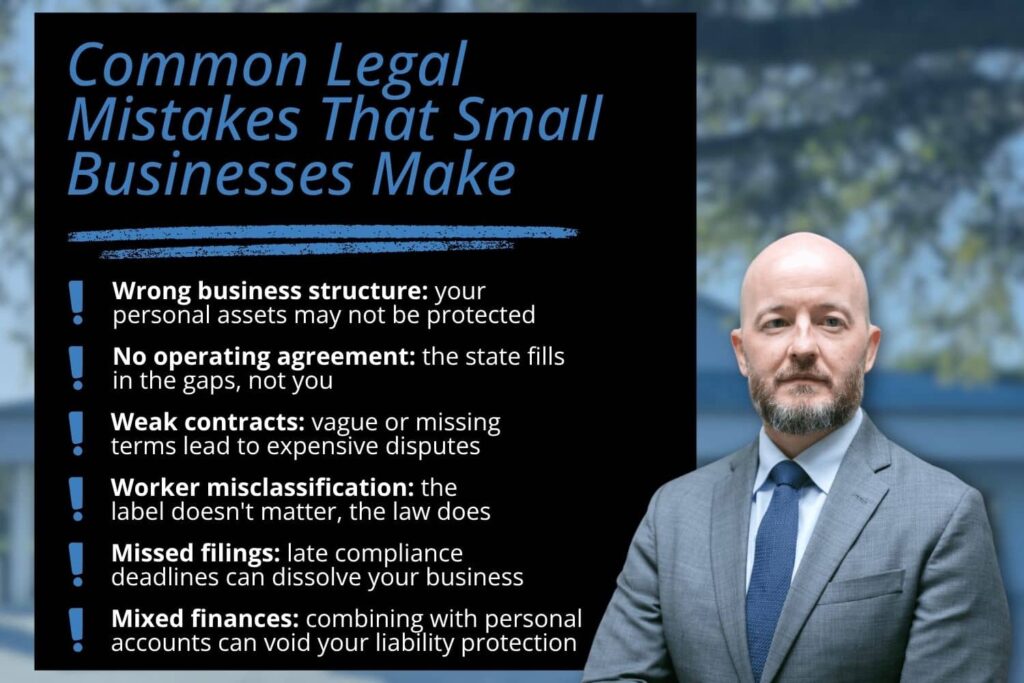
3) Using Weak or Missing Contracts
A handshake deal or a contract template pulled from the internet might feel like enough in the moment. It rarely holds up when things get complicated.
Poorly written contracts are one of the most common triggers for business litigation in Florida.
Vague payment terms, missing scope-of-work language, no dispute resolution clause, and no clear termination provisions all create room for disagreement that eventually lands in an attorney’s office or a courtroom.
This applies across the board: client agreements, vendor contracts, independent contractor arrangements, commercial leases, and partnership agreements. Every business relationship with real financial stakes deserves a contract that reflects what both parties actually agreed to.
4) Misclassifying Workers
There’s a meaningful legal difference between an employee and an independent contractor, and the IRS and Florida Department of Revenue both have specific criteria for how that distinction is made. It’s not simply about what you call someone or what your contract says.
Misclassifying employees as independent contractors to avoid payroll taxes and benefits is a compliance issue that can result in back taxes, penalties, and audits. If a misclassified worker files a complaint or a dispute arises, the business owner typically bears the consequences.
Getting the classification right from the start prevents a messy and expensive correction later.
5) Missing Compliance Deadlines and Filings
Florida businesses have ongoing compliance obligations that don’t pause because you’re busy. Annual reports with the Florida Division of Corporations, state and local business licenses, sales tax registrations, and other required filings all carry deadlines.
Missing them can mean penalties, loss of good standing, or administrative dissolution of your business entity.
A dissolved entity creates real problems. Contracts entered under a dissolved entity may not be enforceable, personal liability protections can be compromised, and reinstatement takes time and money.
Staying on top of your compliance calendar is one of the simpler ways to protect everything you’ve built.
6) Mixing Personal and Business Finances
Using a personal bank account for business transactions or running personal expenses through the business is common among small business owners in the early stages. It’s also one of the fastest ways to lose the liability protection your business structure is supposed to provide.
Courts can pierce the corporate veil and hold an owner personally liable for business debts when personal and business finances are effectively the same thing.
Clean separation between accounts isn’t just good bookkeeping. It’s what makes your LLC or corporation actually function the way it was intended to.
7) Buying or Selling a Business Without Legal Review
Whether you’re acquiring a business or selling one you built, the transaction involves considerably more legal complexity than most people expect. Asset purchase agreements, liability assumptions, non-compete clauses, employee transitions, lease assignments, and due diligence all require careful handling.
Buyers who skip legal review often inherit liabilities they didn’t know existed. Sellers who draft their own agreements sometimes give away protections they didn’t realize they had.
When real estate is tied to the transaction, that adds another layer, particularly in a market like Florida’s Space and Treasure Coast, where commercial property values have shifted significantly in recent years.
Related Questions to Explore
What is the difference between an LLC and a corporation for a Florida small business? Both provide personal liability protection but differ in structure, taxation, and formality. LLCs tend to offer more flexibility and simpler administration. Corporations have a more defined structure that can suit businesses planning to raise outside investment. The right choice depends on the specific goals and circumstances of the business.
When does a business dispute require litigation? Most disputes don’t need to go to court. Negotiation, mediation, and arbitration resolve the majority of business conflicts faster and at lower cost. Litigation becomes the right path when the other party isn’t acting in good faith, when significant money is at stake, or when a contract has been clearly breached.
Does estate planning matter for small business owners? More than most owners expect. Without a plan in place, what happens to the business when an owner becomes incapacitated or passes away is largely out of their hands. A will, a trust, and clearly documented succession arrangements help ensure the business doesn’t fall apart or become a source of conflict during an already difficult time.
When to Call a Professional
Most of the mistakes covered here share a common thread: they happen when legal decisions are made without legal input.
That doesn’t mean every business owner needs an attorney for every decision, but there are moments where getting guidance early saves significant time, money, and stress. Consider reaching out to a business attorney when you are:
- Forming a new business or changing your entity structure
- Bringing on a partner, investor, or key employee
- Drafting or signing any contract with significant financial stakes
- Buying or selling a business or commercial property
- Facing a dispute that isn’t resolving on its own
- Planning for the long-term future of the business
Dill, Evans & Rhodeback has been working with Florida small business owners across the Space and Treasure Coast for over 30 years, offering practical legal guidance across business law, real estate, litigation, and estate planning.
Conclusion
Most small business legal problems aren’t complicated at their root. They stem from missing the right documents, not fully understanding the rules, or not asking the right questions early enough. Sound legal guidance at the right moments goes a long way toward keeping your business protected and operating the way you intended.
If you have questions about your business’s legal foundation, a consultation with Dill, Evans & Rhodeback is a practical place to start.